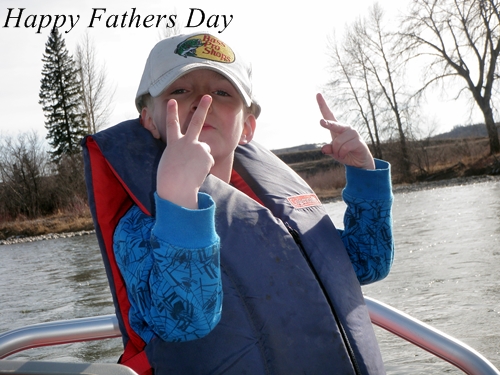
Happy Fathers Day To All Dad’s

fishing the bow river with my boy


Reflections

Quite some time ago when I was a child, I heard my grand dad packing his fishing gear early in the morning. I would rise with him and sit eating Captain Crunch at the kitchen table before he left. “Grandpa, where are you going today I’d say inquisitively”? “I am going trout fishing Michael; I am heading to the river today”. Grandpa would sometimes go fishing with his friends and sometimes he would go alone. “Grandpa, can I go fishing with you”. I was excited at the thought I might be the one who catches those trout. “Sure you can go Michael, fishing is not just for grown ups it’s for kids as well. Get your rod and tackle box ready and put it by the back door”. I ran into my bedroom where I stored my rod and tackle box in the small closet and retrieved my gear. I was ecstatic grandpa let me go fishing with him.

Back in those days before we drove off, we would dig for worms in the flower bed that ran along our back yard fence, or we would stop in at the tackle shop and by some maggots to use for bait. Watering the flower bed to make the worms come to the top of the soil, we gathered up a tub of worms to feed those trout. Grandpa would let me poke the holes in the top of the plastic container we used to hold the bait. We would then drive to the river and string up our fishing line together. The set up consisted of a weight on the bottom of the line and some worms latched onto some snelled hooks tied one and two feet up the line. Grandpa and I would cast our rig out and let the weight bounce on the river bed hoping for a trout to smell our worms and hit. Sometimes we would catch fish and sometimes we did not, I really did not care.

It was time well spent with my grandpa; we bonded and became closer as a result of our fishing adventures. Grandpa taught me respect for the land we fished on. He taught me to ask land owner if we could walk across their property to the river if it was private land. We would pack any garbage out that we brought in. Grandpa was in the Canadian Navy so he had deep respect for the water and all the creatures that lived in it.  Most of all grandpa taught me life’s lesions by the river bank. My grandpa was like my dad! My father moved away to Ontario when I was five so grandpa was my father figure.

With father’s day coming this Sunday, I send out gratitude for all dads who introduce their children to the great outdoors. To all the grandfathers who teach their grand kids the love of nature and the creatures that live in the water, I salute you. The love that is shared when we cast a lure, or fly into unknown water hoping for a glimpse of a fish. The great admiration in a child’s eyes when he or she lands their first fish! When we see our kids grow up and carry on our love of sport fishing and pass it on to their children. That is what brings a big smile to my face and warms my heart.

This father’s day let us share our love for the outdoors with our children. Take them fishing and bond with them beside the river or lake. Teach them how to have fun fishing for whatever that lake or river has to offer. Let’s make it the best father’s day we have ever experienced!

Happy Fathers day friends.

Why Leaving A Prime Fishing Location Is Not A Good Idea

Winter Trout Fishing The Bow River 2011


Never Get Going When The Going Gets Good!

I have seen it time and time again; an angler packs up and leaves a spot when the bite is on. But why?

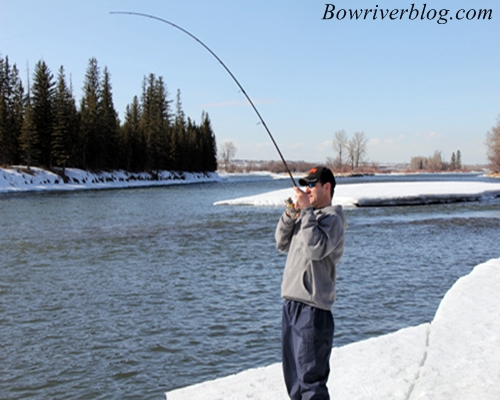
Why do we leave when the bite is on, give up on a prime piece of real estate and go home or go elsewhere on the river? The school is alive; three fish then four and five. Then a short break in the action and were gone. I’ve done it before but I will not do it again! Recently out on a trip with my long time fishing partner Todd Penney, we battled wind and dirty water to hook up with a dozen trout. After a long walk up the river for several miles there were no hits, no nibbles and no trout to be seen. We relocated to a rocky bank side walking down river to reach deep slow moving water. Still no action. Copious casts and nada, zippo, zilch. The fish were fussy and getting the best of us.

Todd suggested we try one more location which meant we had to walk again, this time two more miles upriver. My legs were tired and I was fatigued but I wanted a fish, one fish, any size or color will do. I was desperate and agreed. While walking up the river we talked about what we thought was happening with the trout. Was it the time of day, was it the dirty water conditions or were the fish just plain not feeding? Left baffled and a little dejected, we reached our destination point, an island in the river with tall pine’s that break the river into two channels. At the time, this location had a large ice shelf which divided the river into a side channel that flowed in right where we stood. In past years, we have had many great days here, but with no fish landed I was not convinced today was our day.

A change in lures was in order, I had fished the same lure for an hour and it needed a rest back in my tackle box. I opted for a Blue Fox Minnow Spinner in order to keep the minnow bait from bottom snagging. This lure can work in one inch of water or you can slow down the retrieve and make it work at the bottom. This was the right choice for the structure of the river that day. I launched the minnow spinner far beyond the shallow current that was coming in from that side channel. I did not want to spook a potential taker. As I reeled in I made sure to catch the current of that side channel and let the lure drift with the current. Once my lure was past the shallow shelf and into deeper water, my first taker was hooked in. I was elated and reeled him in so I would not loose the fish. Finally my first fish of the day was out of the way. A quick photo and away he went. What was then about to happen blew both of our minds.

Todd was using a Rapala and he was next to hook a trout, a beautiful rainbow. My following cast employing the same retrieve method, another brown trout was hooked. By the time I could get my fish in, Todd had released his. Todd watched as I landed my fish and released him. The school of trout were just getting fired up; one fish after the other was caught. I landed eight fish a Todd about the same. It was late in the day and the sun was setting. I was tired and wanted to leave the river. Todd wanted to change hooks and stay for another half an hour. I agreed and also switched lures; a Berkley Frenzy Firestick Shallow was tied on and fired out. A few twitches and a Bang, another fish.

We both caught eight to ten fish a piece in that hole I was about to leave. Five fish after I wanted to leave this prime hole. You just never know what the trout are going to do. Keep fishing even when you think that you have caught all of the fish in your location. Switch hooks and use another color, or a different size of lure. Try a spinner instead of a spoon. A twitchbait instead of a crankbait! Never give up on that spot until you are one hundred percent sure that the bite is off. Never get going when the going gets good!

A Focus On Alberta Fisheries Management (Part 1)

Please clean up the river before you leave. We are all responsible for our rivers and lakes!


An Introduction to Alberta’s Wonderful World of Fishes

From the tiny nine-spine stickleback, which grows to a length of only six centimetres to the two-metre long lake sturgeon, Alberta has a very interesting and varied fish fauna. Adjectives such as cool and cold-water, stocked, introduced, native, bait, prey, game and hybrid are used to describe Alberta’s fish species. Of the 62 species of fish in Alberta, 41 species go unnoticed by most people. Generally, these species are small in size, and provide food for fish-eating birds and mammals, and for other fish. With names like northern redbelly dace, emerald shiner, brassy minnow, longnose sucker, slimy sculpin and Iowa darter, these fishes represent a wide range of environmental adaptations, physical characteristics and behaviors.

The remaining 21 species of fish are called game or sport fish, and are of interest to anglers, and commercial and domestic fishers. Sixteen of these species are native to Alberta and five species have been introduced to this province through stocking. Three of the native game species — sauger, mooneye and cisco — are not well known.

The five species of game fish that have been introduced to Alberta are (eastern) brook trout, brown trout, golden trout, smallmouth bass and Dolly Varden (different from our native bull trout, which people used to call Dolly Varden). Most were introduced in the early to mid part of the 20th century either as experiments by fisheries managers or by individuals acting on their own initiative. Rainbow trout are mostly introduced; the only native populations of rainbow trout exist in the Athabasca River and drainage. The brook, brown, golden and rainbow trout have become integral components of the game fish fauna of Alberta, while the other two introduced species have not. The Dolly Varden occur only in Chester Lake near Canmore and smallmouth bass may still exist in Island Lake, north of the town of Smoky Lake.

Other introduced species (non-game) that have developed self-sustaining populations include, goldfish in Henderson Lake in Lethbridge and the threespine stickleback in Hasse Lake. These species were illegally introduced. The introduction of the sailfin molly, African jewelfish and western mosquito fish in the Cave and Basin hotspring in Banff National Park probably contributed to the 1988 extinction of the Banff longnose dace, which lived in the ponds below the hot springs. The Banff springs snail is an endangered species (2000), due to fish introductions and other human impacts at the Banff springs. The introduction of new species or even the transfer of fish from one water body to another can threaten the viability of existing fish populations, spread disease and compromise the integrity of our aquatic ecosystems.

Fish are Important to Albertans – Food, Recreation and Economic Benefits.

The Domestic Fishery – Indian subsistence or “domestic” fishing provides opportunities for Treaty Indians to fish for food for their household needs – a traditional use of Alberta’s fish resource. The Indian food fishery is recognized in law and by government policy. Domestic Fishing Licenses are free and allow Indians to fish for food with a net. Other forms of Domestic Fishing Licenses available from Alberta Sustainable Resource Development include: Métis Domestic Fishing Licenses issued to residents of Métis Settlements only for lakes on or adjacent to Métis Settlement Lands; and Domestic Fishing Licenses issued to individuals after approval of an application showing a need to fish for food for subsistence purposes.

The Sportfishery – Each year over 320,000 anglers spend approximately $340 million on goods and services related to sport fishing in Alberta. In 2000, the most recent year for which information is available, anglers spent the equivalent of more than 2.9 million days fishing, catching more than 12 million fish, of which over 10 million were released and about two million were kept. Ice fishing, fishing stocked water bodies and catch-and release fishing are gaining in popularity. Relaxation, enjoyment of nature, family togetherness, challenge and excitement, catching fish to eat, and improving fishing skills are reasons anglers go fishing.

The Commercial Fishery – Commercial fishing in Alberta involves primarily the gill-net fishery, but commercial baitfish fishing operations and the fishing lodge industry are considered part of the overall commercial fishery, too. Commercial fishing with gill nets has been carried out in Alberta since the late 1800s. This fishery targets Lake Whitefish, but lake trout, walleye, northern pike, yellow perch, Cisco and goldeye are also caught. Commercial fishing regulations are set to minimize the incidental or by-catch of non-target species. In 1999/2000 the commercial (gill net) fishing industry produced 2.2 million kilograms of fish valued at $3.2 million to local economies. More than 85% of this harvest consisted of Lake Whitefish and Cisco. The majority of this fishing occurs during the winter months when the best prices can be gained. The catch is sold either through the Freshwater Fish Marketing Corporation, a federal crown corporation that supplies mainly export markets, or directly to consumers. Approximately 40% of the commercial fishing catch is sold directly to Albertans. ?

Healthy Fish Populations are Indicators of Healthy Ecosystems

Although fish are valued mainly as a source of food, recreation and economic returns, Albertans’ interest in fish, their habits and aquatic environments is growing with increased environmental awareness. Fish populations are sensitive. Therefore, healthy, uncontaminated fish populations can indicate a healthy aquatic environment. The presence of fish can tell us that smaller prey fish species and the small aquatic organisms they eat exist in large numbers. Healthy fish populations can also help the survival of predators like osprey, fishers, mink and bears.

Fish Viewing Opportunities and a Source for Scientific Study

While perhaps not as dramatic or well-known as spawning runs of salmon in British Columbia, there are opportunities to view fish in their natural environment in Alberta. In September, bull trout can be observed spawning in Smith-Dorrien Creek (a tributary of Lower Kananaskis Lake), in the Elbow River between Elbow Falls and Canyon Creek, and in the Sheep River between Sheep Falls and Gorge Creek. Volunteers have helped tag, measure and weigh spawning bull trout as part of a special study conducted at Smith- Dorrien Creek. Each year many scientific studies are conducted to expand our knowledge of our fish resources and aquatic ecosystems. The public can view fish-rearing areas and interpretive displays at both the Cold Lake and Sam Livingston fish hatcheries as well as at the Raven and Allison Creek brood trout rearing stations near Caroline. Currently, work is underway to develop a world-class education and interpretive centre, called the Bow Habitat Station, at the Sam Livingston Fish Hatchery in Calgary.

The original source of this article lives here http://www.whyte.org/time/riveroflife/fishmgmt.pdf

A Focus On Alberta Fisheries Management (Part 2)


Bow River Rainbow Trout Fishing 

Managing Our Fisheries Resources

The Demand for Fish Exceeds Supply

Alberta does not have an abundance of fish habitat; only 2.4 percent of Alberta is covered with fresh water. About 800 Alberta lakes contain native game fish populations. Compare this to Saskatchewan’s estimated 94,000 fish-bearing lakes, Manitoba’s 110,000 and Ontario’s 250,000! Another 250 to 300 Alberta water bodies (such as municipal ponds) are stocked annually with rainbow trout. Alberta’s human population has been quickly increasing over the past 30 years. Most people live in the central and southern parts of the province, while most of our fish-bearing waters are in the north. This results in a high demand on the fish resources in the more accessible waters. Fish populations in Alberta have declined as a result of over harvest and habitat alteration.

Other factors can place more strains on the population. Several species of prey and sport fish are known to hybridize or reproduce with other genetically similar species. For example, white suckers hybridize with longnose sucker, and lake whitefish hybridize with Cisco. While this is a natural phenomenon occurring when similar species spawn in the same area at the same time, hybridization
becomes a concern when native fish hybridize with non-native fish, such as Cutthroat Trout hybridizing with rainbow trout. These hybrids, called cutbows, along with all other hybrids, are sterile and use food and space needed by other fish which can reproduce and help sustain the population. In addition, these hybrids dilute the gene pool of sport fish native to the watershed.

How Are Our Fish Resources Managed?

Actually, it’s not the fish resources that are managed; it’s the users of the resource who are managed with regulations concerning how, when, where and how many fish can be harvested. The impacts of all users — recreational (sport), domestic and commercial — are taken into account, including angling release mortality and the by catch of non-target species in domestic and commercial fishing.
Managing for conservation requires both the control of fish harvest and the protection of fish habitat. While Alberta Sustainable Resource Development is responsible for managing our fish resources, Alberta Environment, through the Water Act, protects the aquatic environment and ensures the wise use of water resources.

Tools used by fisheries managers to regulate the sport fishery include season and area closures to protect spawning fish, catch limits to distribute the available harvest of fish among many users, size limits to ensure enough fish of spawning size survive to sustain the population, gear restrictions to support ethical conduct, and bait restrictions to ensure hooks are not taken too deeply, causing hooking mortality. Careful handling and quick release increases fish survival. For the domestic net fishery, license holders are authorized to set one net of 95 meters (100 yards) per lake; a minimum mesh size is specified so that only the larger, mature fish that have already spawned a number of times are harvested. Streams and rivers, and the mouths of tributaries, are closed to fishing so that over harvest does not occur, and at certain times of the year, areas in some lakes are closed to fishing in order to protect spawning fish. In addition, depth restrictions, or controlling the depth at which nets can be set, protect vulnerable fish stocks while still allowing the harvest of more plentiful fish species such as lake whitefish. Fish caught by domestic fishing license holders are for their household use only as a source of food and cannot be sold.

Participation in the commercial net fishery is also tightly controlled. Licensed fishermen must abide by gear restrictions, and season and area closures, including depth restrictions. Most commercial fishing regulations are geared to maximize the catch of target species such as lake whitefish, while minimizing the incidental catch of non-target species such as walleye, northern pike and lake trout. Quotas for the maximum amount of a target species that can be harvested are set on a lake-by-lake basis, as are tolerance limits for the maximum amount of non-target species that can be harvested. Each commercial fishery is monitored closely and closed once a target species quota or a non-target species tolerance limit is met or exceeded.

The Regulation-setting Process

The regulation-setting process seeks to strike a balance between the desires of the users of the resource (demand) and the resource available to be used (supply). This process relies on clear, two-way communication between fisheries managers and the public. The exchange of scientific data and user expectations result in better regulations and better regulation compliance.

During the development of management and recovery plans for walleye, northern pike and the eastern slopes trout fisheries, there was extensive public consultation. The regulations that resulted from this process are complicated in that they are water body/species specific. Biologists and anglers agree that this is the best way to recover and maintain fish populations because the allowable harvest is linked to the productive capability of each fish population and the productive capacity of the water body.

In the future, regulations may begin to take into account the interactions of species, so that regulations for all species in a water body, especially where species such as walleye and northern pike compete for the same food source, will be adjusted to provide the fishery the public desires. For example, this could mean developing regulations to support a good walleye fishery or a good pike fishery, in place of regulations that would have supported only an average walleye/pike fishery. However, this requires a great amount of information about each water body and population.

Critical to the regulation-setting process is information on the age and size distribution, and growth rates of each fish population. With the assistance of the Alberta Conservation Association, volunteers, and conservation groups such as Alberta Fish and Game Association and Trout Unlimited, fish population inventories are conducted using such tools as creel census, test netting and electrofishing. Information on spawning success and recruitment (rate of
reproduction) is very important as well.

Making Sense of Regulations

Some of the regulations require the angler to have a clear understanding of fish biology for the regulations to even make sense. For example, some anglers believe that large fish produce the most eggs and therefore should be released. This belief is contrary to fish biology; biologists know that having more medium sized fish in a population is more beneficial because their egg-producing capacity is greater than that of a few large fish. And the eggs are of better quality, too. Minimum-size limits are good management tools that protect fish populations while providing anglers with an opportunity to catch and keep large fish.

Fish Stocking

It is illegal to release live fish or live fish eggs into any waters except back to the waters from which they were taken. The Alberta Government’s fish stocking program (currently administered by Alberta Sustainable Resource Development) is one exception to this rule. Each year, about four million fry and fingerlings from different species of sport fish are raised and stocked in reservoirs, lakes, and constructed ponds which cannot support a native fish population. This is done to provide the public with a variety of sport fishing opportunities while taking some pressure off “wild” (non-stocked) fish populations. All fish stocking is consistent with water body management plans, which consider criteria such as water quality, physical characteristics, public interest and the characteristics of existing fish populations.

Protecting Fish Habitat

An equally important aspect of managing our fish resources involves managing people’s activities where fish habitat is concerned. Fish are a product of their habitat, and to produce fish there must be sufficient, suitable habitat available. Work in and around water bodies must result in “no-net-loss”. In some cases adverse impacts are temporary and steps can be taken to minimize these impacts
(mitigation). Longer-term impacts may require other steps to replace or offset the loss of fish habitat (compensation).

Activities that are affected by the guideline of no-net-loss of productive fish habitat include recreational development, timber harvest, agriculture and cattle grazing, petroleum and mineral exploration and extraction, and any other activitythat may affect the aquatic environment. Developers must identify critical habitats for all life stages of the fish affected. Appropriate habitat protection, rehabilitation
and compensation measures need to be included in development plans. The
effectiveness of habitat rehabilitation and compensation actions must be monitored and maintained.

Species of Concern Have a Brighter Future

By the mid-1990s, populations of bull trout, Alberta’s official fish emblem, had declined severely due to over harvest and habitat alteration. However, sport fishing regulations prohibiting the harvest of bull trout (zero catch limit) implemented in 1995 are already having a positive affect. In Lower Kananaskis Lake, where harvest has been prohibited since 1992, there are reports of increased bull trout catch rates and slower growth rates for these fish, both signs of population recovery. Elsewhere in the eastern slopes there are reports that the numbers and size of bull trout are increasing. Again, it is important to know something about fish biology to understand the regulations. While anglers may see an increased
number of bull trout, they should also know that bull trout are not ready to spawn until they are about six years of age, and usually over 40 cm long!

Management plans developed from 1996 to 1998 to maintain and recover populations of walleye, and east slopes cold-water fish species such as Arctic grayling, rainbow trout, brown trout and cutthroat trout have brought into place more restrictive regulations. But the restrictions are also more realistic
considering the productive capabilities of these populations and current angling pressure.

The original source of this article lives here http://www.whyte.org/time/riveroflife/fishmgmt.pdf